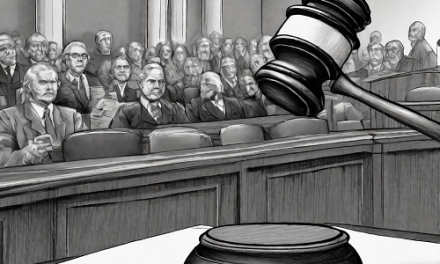

On Friday, July 18, 2025, the Colorado Independent Judicial Discipline Adjudicative Board publicly censured former District Court Judge Justin B. Haenlein for misconduct, marking the first disciplinary action taken under a new judicial discipline framework established by a constitutional amendment passed by voters last year.
The public censure was issued following an agreement between Haenlein and judicial discipline authorities, which he accepted prior to his resignation. However, the panel emphasized its authority to impose sanctions beyond what was agreed upon, reaffirming its jurisdiction under the Colorado Constitution.
The disciplinary panel consisted of three members: Weld County District Court Judge Vincente G. Vigil, attorney Tyrone Glover, and non-lawyer Jeff Swanty. In its order, the panel stated, “While it accepts the parties’ stipulation in this instance, such acceptance does not constitute a limitation on the Panel’s constitutional authority to impose any sanction within its jurisdiction.”
Amendment H, enacted by voters in 2024, restructured the judicial discipline process to reduce the involvement of the Colorado Supreme Court. It established an adjudicative board to oversee formal disciplinary proceedings, comprising judges, attorneys, and non-lawyers appointed by various entities. The panel is also responsible for creating emergency disciplinary rules.
Haenlein, who served in the 13th Judicial District covering several northeastern Colorado counties, had been suspended from the bench since November 2024 while a disciplinary investigation was underway. He resigned in April 2025, arguing that the adjudicative panel lacked clearly defined rules and procedures, potentially infringing on his constitutional right to due process.
In a separate filing, Haenlein’s attorney, David M. Beller, claimed that the panel could only impose the public censure stipulated by the parties. Despite these arguments, the panel’s order reiterated that Amendment H granted it broader authority, including the power to impose counseling, docket supervision, and judicial education for judges.
The panel stated, “The Panel retains full discretion to determine appropriate sanctions in all matters before it, and parties cannot through stipulation limit the Panel’s constitutional remedial authority.” It reserved the right to evaluate future stipulations based on their merits and to reject any that do not serve the public interest or the integrity of the judiciary.
Haenlein was appointed as a judge in January 2022, following a career in criminal defense and child welfare law. During his tenure, he represented a client referred to as “Jane Doe” in various criminal cases and engaged in inappropriate exchanges with her through text messages, which included sexual content.
At the time of his appointment, Haenlein was still involved in a domestic relations case for Doe. Although he withdrew from that role, he continued to give her legal advice using the Judicial Department’s case management system, even while presiding over her felony drug case. He disclosed their prior attorney-client relationship but did not mention their personal connection during her court appearances.
Throughout the proceedings against Doe, Haenlein made several procedural rulings and ultimately sentenced her following a guilty plea. He also granted a request to release her boyfriend, who faced serious felony charges, without disclosing his personal ties to the case.
The adjudicative panel concluded that Haenlein had violated judicial rules by failing to recuse himself, not promoting public confidence in the judiciary, and practicing law while serving as a judge.
A copy of the original filing can be found here.