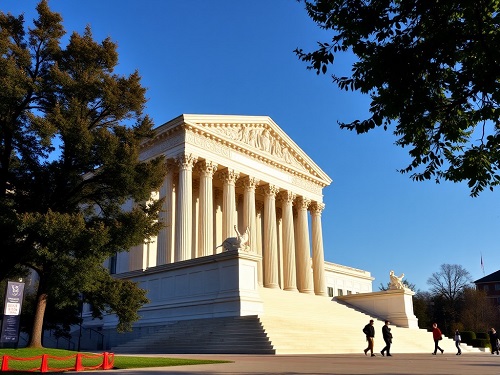
On Wednesday, January 15, 2025, Ryan Reft, a historian in the Manuscript Division at the Library of Congress, published an article titled “Corruption, Compliance and Conscience: A Glimpse Into Supreme Court Ethics Scandals” on The Saturday Evening Post website, examining the history of ethical controversies within the U.S. Supreme Court. The article traces the evolution of judicial ethics from the early 20th century to the present day, highlighting key scandals and their impact on the development of ethical guidelines for judges.
The piece begins by drawing a parallel between the 1919 Black Sox scandal in baseball and the need for ethical standards within the judiciary. Following the baseball scandal, Federal Judge Kenesaw Mountain Landis was appointed as the first commissioner of Major League Baseball, tasked with restoring public trust. Landis’s simultaneous holding of his judicial position and the baseball commissionership prompted a House of Representatives investigation, ultimately leading to his resignation from the bench. This event spurred the American Bar Association (ABA) to create the 1924 Canons of Judicial Ethics, a set of guidelines for judicial conduct that, while influential, lacked enforcement mechanisms.
The article then focuses on two significant Supreme Court ethics scandals of the late 1960s: those involving Justices Abe Fortas and William O. Douglas. Justice Fortas faced scrutiny for accepting a lifetime annuity from the Wolfson Family Foundation, a matter he was initially deceptive about. This, coupled with his misleading testimony to Congress regarding his advice to President Lyndon B. Johnson, led to calls for his impeachment. Fortas ultimately resigned from the Court in 1969 to avoid impeachment proceedings. His resignation prompted significant soul-searching within the judiciary, with other judges taking steps to avoid similar controversies.
Simultaneously, Justice William O. Douglas faced impeachment calls, primarily fueled by his personal life and allegations of associating with a known pornographer. These accusations, alongside claims of ties to organized crime and undermining national security, were brought to the House floor by Minority Leader Gerald Ford in 1970. Unlike Fortas, Douglas chose to fight the impeachment attempt, garnering support from prominent legal figures. The effort ultimately failed, and Douglas remained on the Court until his retirement in 1975.
The article notes that the Supreme Court historically resisted the imposition of a binding code of judicial ethics, preferring instead a policy of self-governance. Following the Fortas scandal, Chief Justice Earl Warren attempted to introduce a binding code through the Judicial Conference, but failed to secure the support of his fellow Justices. Subsequent attempts at reform, including a revision of the Canons of Judicial Ethics by the ABA in 1973, also lacked effective enforcement mechanisms.
The article continues by outlining the ongoing challenges in upholding judicial ethics in the 21st century. Controversies in the early 2000s led to concerns about insufficient oversight by the Judicial Conference and judicial councils. Chief Justice William Rehnquist established the Breyer Committee in 2004 to address these issues, resulting in limited reforms. Chief Justice John Roberts later emphasized the Justices’ adherence to existing financial disclosure and disqualification requirements, arguing against the need for a separate ethics code.
It wasn’t until 2023, amidst renewed ethical concerns, that the Supreme Court finally adopted a binding ethics code. However, the article highlights criticism of this code’s lack of enforcement mechanisms, a point acknowledged by Justice Elena Kagan. The article concludes by using the film The Untouchables as a metaphor, illustrating that the perception of ethical breaches, regardless of actual proof, can significantly erode public trust in the judicial system. The lack of a robust enforcement mechanism for the newly adopted code remains a significant concern.
Source: The Saturday Evening Post