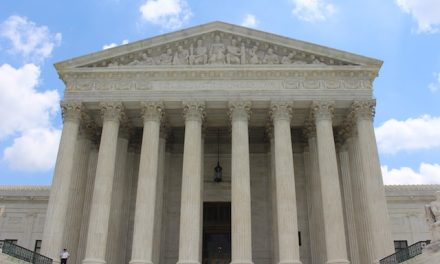

On Thursday, January 23, 2025, The Carolina Journal reported that the North Carolina Supreme Court decided to send Republican candidate Jefferson Griffin’s election complaint back to the Wake County Superior Court. This ruling prevents Griffin from bypassing the normal judicial process in his attempt to block the counting of over 65,000 votes in his election against Democrat Allison Riggs.
The Supreme Court’s decision, which was reached by a 5-1 vote, requires that the trial court address Griffin’s challenge to the election results. This development comes as the 4th U.S. Circuit Court of Appeals prepares for oral arguments regarding the same issue on Monday.
Griffin had initially filed his complaint on December 18, 2024, directly with the state Supreme Court, seeking a writ of prohibition against the State Board of Elections. However, his request skipped the usual judicial procedures. After the case transitioned to federal court, it returned to the North Carolina Supreme Court on January 6, 2025. The next day, the court issued a temporary stay, halting the certification of Riggs as the winner of the November 5 election, where she currently leads Griffin by 734 votes amid more than 5.5 million ballots cast statewide.
In the order signed by Justice Trey Allen, the court stated, “The Court on its own motion dismisses the petition for writ of prohibition so that the Superior Court of Wake County may proceed with the appeals that petitioner filed.” The order also indicated that the temporary stay will remain in effect until the Wake County Superior Court rules on Griffin’s appeals and any subsequent appeals are exhausted. The court has directed the Superior Court to act promptly.
Justice Anita Earls, the only Democratic member of the court alongside Riggs, did not participate in the decision. However, she concurred with the dismissal of Griffin’s writ of prohibition but dissented regarding the continuation of the temporary stay. Earls expressed concern that the court’s decision effectively functions as a preliminary injunction, which she argued is typically granted only when there is a likelihood of success on the merits of a case.
Earls criticized the majority for potentially enabling frivolous litigation by losing candidates, warning that this could undermine confidence in the democratic process. “If any losing candidate can make any sort of argument about votes in the election, no matter how frivolous, and automatically receive a court-ordered stay on appeal, preventing the winning candidate from being certified, nothing stops litigious losers from preventing duly elected persons from taking office for months or longer,” she stated.
Chief Justice Paul Newby, who authored one of four concurring opinions, defended Griffin’s right to pursue his election challenge. He emphasized that the case is not about determining the election’s outcome but about maintaining public trust in electoral processes. Newby noted the unusual circumstances of the election, where Griffin initially led by nearly 10,000 votes before trailing Riggs.
He maintained that it is not anti-democratic to file an election protest, highlighting that the procedures are established by the General Assembly to allow inquiries into election results. Newby referenced previous unresolved election contests in North Carolina to illustrate the importance of following legal procedures.
Notably, he pointed out that delays in Griffin’s case were due to the State Board’s actions, which included moving the case from state court to federal court multiple times. Newby remarked on the need for the State Board to adhere to the established legal review process.
Justices Phil Berger Jr. and Tamara Barringer also supported Newby’s position in their separate concurring opinions. Berger remarked on the importance of ensuring that those who enforce election laws do so faithfully. He argued that while the case should be resolved in Superior Court, it was inappropriate for the Supreme Court to intervene at this stage.
Barringer advocated for a more efficient resolution, suggesting that the court should utilize its constitutional authority to expedite the process instead of allowing the case to drag on.
Justice Richard Dietz, in his concurrence, distinguished Griffin’s situation from previous cases where candidates accused the elections board of violating rules during vote counting. He asserted that the State Board followed existing election rules and that Griffin’s claims relate to the legality of those rules rather than their enforcement.
Dietz indicated that Griffin’s arguments might violate the state version of the Purcell principle, which discourages changes to election rules during an election cycle. He noted that the North Carolina Supreme Court has not previously recognized this principle, but he believes it is time to consider it.
The Supreme Court’s decision rendered Riggs’ request for oral arguments moot. Griffin’s legal team recently requested that the 4th Circuit postpone its scheduled hearing in light of the state Supreme Court’s ruling. Riggs and the State Board of Elections opposed this request.
Source: The Carolina Journal