
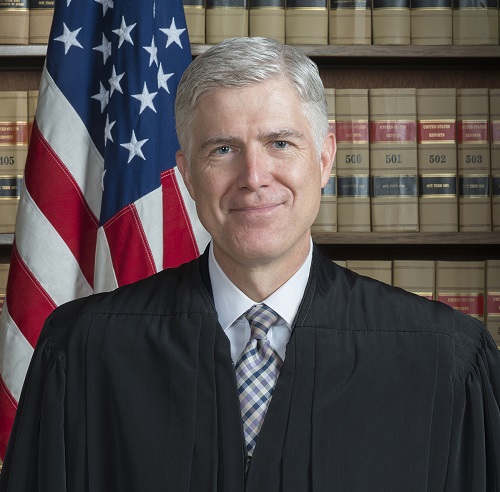
On Thursday, December 5, 2024, Mark Joseph Stern, a Slate senior writer, published an article critiquing Supreme Court Justice Neil Gorsuch’s recent decision to recuse himself from an environmental case, a move that raised questions about his ethical standards. The recusal occurred just days before oral arguments in the case, known as Seven County Infrastructure Coalition v. Eagle County, which involves a proposal for an 88-mile railway designed to connect Utah’s Uinta Basin to existing rail networks for crude oil transportation.
In a letter sent by Supreme Court clerk Scott Harris, it was announced that Gorsuch would no longer participate in the case, citing the new ethics code established by the court. However, Stern highlighted the timing of Gorsuch’s decision as ironic, particularly following a New York Times report that detailed Gorsuch’s prior opposition to stricter ethics requirements for the justices. According to the report, Gorsuch played a significant role in lobbying against enforceable ethics regulations, contributing to a situation where accountability would depend on public pressure rather than formal rules.
Stern pointed out that Gorsuch has longstanding connections with billionaire Philip Anschutz, a key figure who stands to gain significantly from a favorable ruling in the case. Prior to his appointment to the Supreme Court, Gorsuch represented Anschutz and his companies while in private practice. Despite this history, Gorsuch did not recuse himself when the case was accepted by the Supreme Court in June, nor when Anschutz’s company submitted a brief in support of limiting environmental reviews in September.
The article detailed that Gorsuch had previously recognized potential conflicts of interest, having recused himself from numerous cases involving Anschutz and his businesses while serving on lower courts. However, critics noted that Gorsuch’s response to the scrutiny surrounding his involvement in Seven County was delayed, even after progressive groups and Democratic lawmakers called for his disqualification from the case.
Stern emphasized that Gorsuch’s recusal, arriving two weeks after public demands for him to step down, does not necessarily reflect a commitment to ethical conduct. Instead, it may be seen as a strategic move to avoid distraction during a critical moment for the court, particularly as the conservative majority appeared poised to support the oil industry’s interests.
The article also discussed the broader implications of the Supreme Court’s lack of enforceable ethics rules, a situation partly attributed to Gorsuch’s influence. The new ethics code, described as vague and lacking mandatory enforcement mechanisms, has led to concerns about the integrity of the court. Stern noted that without authoritative oversight, justices may face public criticism as the only means of accountability.
Despite the ethical questions raised by Gorsuch’s recusal, the article pointed out that the legal standards for recusal are not absolute. While it is generally expected that justices should withdraw from cases where their impartiality could be reasonably questioned, the ethics code allows for some discretion. Critics argue that this ambiguity leaves room for justices to make questionable decisions without fear of formal repercussions.
Stern concluded that Gorsuch’s “eleventh-hour recusal” does not equate to a genuine acknowledgment of ethical responsibility. The article suggested that the current system for addressing potential conflicts of interest within the Supreme Court is inadequate, emphasizing the need for clearer and more enforceable ethical guidelines to restore public confidence in the judiciary.
Source: Slate