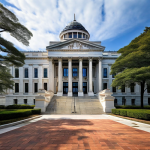

On Monday, May 26, 2026, Newsweek reported that U.S. Supreme Court Justice Amy Coney Barrett recused herself from a case involving federal inmate Andrew Johnston, who assisted in a high-profile cartel investigation.
Johnston, currently held at the Metropolitan Correctional Center in Chicago, had petitioned the Supreme Court to review his sentence, but his request was denied for a second time. The denial occurred because Justice Barrett recused herself. Had the court granted Johnston’s petition, the Seventh Circuit Court of Appeals would have been compelled to review a lower district court’s decision that denied Johnston a 25 percent sentence reduction.
Barrett’s recusal reportedly stems from her prior involvement in the litigation during her time on the lower courts. While she does not formally explain her reasons for recusal, Newsweek reports that records from a 2020 appeal clarify a conflict of interest. Johnston had filed two writs of certiorari with the Supreme Court in an effort to compel the Seventh Circuit to hear his appeals.
In a handwritten 2020 petition, Johnston noted that he was convicted in 2019 and sentenced to 168 months in prison. He stated that he submitted his notice of appeal to the courtroom clerk immediately following his sentencing, which is when Barrett became involved. On May 3, 2019, Barrett, then a Circuit Judge, granted Johnston leave to prosecute his appeal pro se. As such, when Johnston first appealed to the Supreme Court in 2021, Barrett recused herself. She also recused herself from Johnston’s subsequent appeal this year.
Barrett has previously outlined her judicial philosophy regarding recusals, noting that requiring justices to state their reasons carries institutional “costs.” She has stated that the vast majority of recusals stem from financial conflicts, which are already accessible to the public through mandatory federal financial disclosures. Justices also traditionally recuse themselves from reviewing cases they previously ruled on during their tenures on lower courts.
Johnston’s legal battle began with a conviction for attempted bank robbery, resulting in a 168-month prison sentence imposed by the U.S. District Court for the Northern District of Illinois. While incarcerated, Johnston cooperated with federal authorities in an investigation targeting a member of the Sinaloa Cartel.
As part of his cooperation, Johnston intercepted a conversation with a cartel figure and alerted prison officials to a contract on Lopez-Serrano’s life. In exchange for his cooperation, the government moved to reduce Johnston’s sentence by 25 percent, but the district court only awarded a 10 percent reduction because the court felt Johnston lacked remorse for the attempted bank robbery. On October 29, 2025, the Seventh Circuit affirmed the lower court’s ruling.
Source: Newsweek