
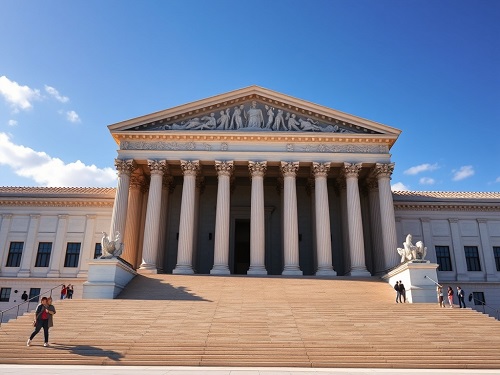
On Thursday, September 11, 2025, Politico reported that federal appeals court judges are expressing frustration over the Supreme Court’s handling of emergency docket rulings. During a session at the 4th Circuit Court of Appeals in Richmond, judges openly discussed the challenges of interpreting the Supreme Court’s often brief and unexplained orders.
The judges are grappling with how to adhere to the Supreme Court’s guidance while also fulfilling their constitutional duty to provide detailed rulings in complex cases.
Judge James Wynn, an Obama appointee, voiced concerns about the lack of direction from the Supreme Court, stating that the circuit and district courts are left in limbo. He suggested the Supreme Court could easily provide more clarity in its rulings. Wynn also emphasized the importance of the Supreme Court providing reasoning for their decisions to aid lower courts in following the law.
“They cannot get amnesia in the future because they didn’t write an opinion on it. Write an opinion,” Wynn said. “We need to understand why you did it. We judges would just love to hear your reasoning as to why you rule that way. It makes our job easier. We will follow the law. We will follow the Supreme Court, but we’d like to know what it is we are following.”
Judge J. Harvie Wilkinson III, a Reagan appointee, noted that the Supreme Court’s actions must have significance. “It doesn’t do these things just for the kicks of it,” Wilkinson added.
The uncertainty stems from a July order where the Supreme Court stated that lower courts must follow its rulings on the emergency docket, even in cases that have not yet been fully reviewed by the high court.
The 4th Circuit judges are not the first to raise concerns about the Supreme Court’s emergency docket decisions. U.S. District Judge Allison Burroughs previously stated that the Supreme Court’s rulings on the Trump administration’s efforts to end government grants lacked clarity and sometimes appeared to shift the law without sufficient explanation or consensus.
Similarly, the 1st Circuit Court of Appeals in Boston struggled to interpret a Supreme Court emergency order regarding Education Department layoffs and its effect on a case involving the dismantling of smaller government agencies. The 1st Circuit panel ultimately determined that the cases were not similar enough to warrant applying the Education Department ruling.
The public discussion among the 4th Circuit judges highlights the ongoing confusion in lower courts about how to implement the Supreme Court’s emergency docket decisions, particularly when detailed reasoning is absent. This issue is compounded in a case concerning access to Social Security Administration data by the Department of Government Efficiency (DOGE).
In June, the Supreme Court overruled the 4th Circuit’s decision and lifted an injunction against DOGE’s use of the data. The Supreme Court, by a 6-3 vote, stated that the injunction would remain on hold until the case returned to the Supreme Court, without providing a substantive rationale for the lower court.
During the arguments, some of the 15 judges present suggested issuing a one-line opinion to lift the injunction and return the case to the Supreme Court. Other judges argued they were obligated to consider and rule on the case, regardless of the Supreme Court’s decision.
Judge Albert Diaz, an Obama appointee, noted that some colleagues believed no further work was necessary due to the Supreme Court’s guidance. Judge Robert King, a Clinton appointee, cautioned against prematurely ending the case, emphasizing the oath and duty of the court.
Source: Politico


