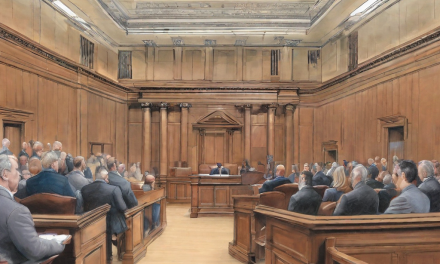
On Wednesday, September 11, 2024, Metropolitan News-Enterprise reported that the California Commission on Judicial Performance publicly admonished San Mateo Superior Court Judge Susan L. Greenberg for her actions during a civil harassment restraining order hearing that violated a litigant’s rights.
The commission’s rebuke stems from an incident that occurred on June 14, 2022, during the case of Lopez v. Chicas, 22-02096. Judge Greenberg presided over a hearing intended to address a civil harassment restraining order. The case was initially called by Judge Leland S. Davis III at 9 a.m.; however, the defendant, Henry Chicas, along with his attorney, Diana Passadori, was not present at that time.
Following the absence of the defendant, Judge Davis transferred the case to Judge Greenberg. When the case was called, Judge Greenberg noted that only the petitioner, Andrea Vanessa Villalta Lopez, was present, while the defendant arrived late, at approximately 9:32 a.m. Judge Greenberg ruled that Chicas would not be allowed to participate in the proceedings due to his late arrival.
Passadori explained to the court that Chicas had been waiting outside the previous courtroom, uncertain about his right to enter due to COVID-19 protocols. Passadori further indicated that she was late because she had to appear at 8:30 a.m. for another matter. Despite this explanation, Judge Greenberg remained firm in her decision, stating that the defendant’s lack of timely appearance was “absolutely unacceptable.” The judge subsequently denied Passadori’s request for a continuance and issued a permanent civil harassment restraining order against Chicas, prohibiting any contact with Lopez.
On May 11, 2023, the First District Court of Appeal reversed Judge Greenberg’s decision in an unpublished opinion authored by Justice Ioana Petrou. The appellate court found that California’s Code of Civil Procedure §527.6 mandates that judges must consider any relevant testimony in cases regarding civil harassment restraining orders. The court concluded that Judge Greenberg’s refusal to allow Chicas to testify constituted an abuse of discretion.
The commission’s decision highlighted that denying Chicas the opportunity to defend himself represented a disregard for his due process rights, rendering the hearing fundamentally unfair. The commission noted that Judge Greenberg should have recognized that preventing a litigant from being heard raises significant due process concerns. Furthermore, the judge’s actions appeared to reflect bias and retaliation against Chicas due to his attorney’s actions in being late to court, rather than fulfilling her judicial responsibilities impartially.
In addition to the commission’s findings from this incident, it took into account Judge Greenberg’s prior disciplinary history as an aggravating factor. In 2017, she had been privately admonished for failing to disclose campaign contributions from two attorneys who appeared before her. In another case involving child custody, she appointed a guardian ad litem without notifying the litigant or allowing them to object, raising further concerns about her adherence to due process.
Judge Greenberg began her judicial career after winning a primary election on June 3, 2014, and subsequently took office in January 2015 following an appointment by then-Governor Jerry Brown. Prior to her judgeship, she served as a deputy district attorney and was a commissioner at the San Mateo Superior Court from 2000 until her appointment as a judge. Greenberg earned her law degree from Hastings College of the Law in 1984.
Source: Metropolitan News-Enterprise