
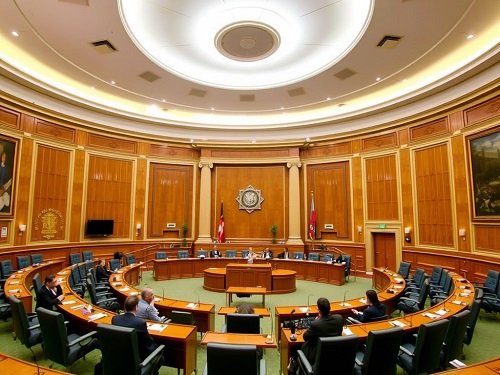
On Saturday, December 7, 2024, The Denver Gazette reported that several judges who faced disciplinary actions have reemerged in municipal court positions across Colorado, raising concerns about accountability in the judicial system. This issue came to light following the resignation of 18th Judicial District Judge Natalie Chase, who stepped down amid allegations of inappropriate racial comments and subsequently secured part-time judicial roles in Deer Trail and as a traffic referee in Fort Collins.
Chase’s case is part of a broader trend involving at least six judges who have resigned or retired over disciplinary issues in the past decade. Most of these cases involved private sanctions that were not disclosed to the public. The Colorado Code of Judicial Conduct mandates that state court judges self-report infractions, but this requirement does not extend to municipal court judges unless explicitly mandated by the local government.
Typically, judges who are compelled to resign sign consent orders with the Judicial Discipline Commission, which prevent them from returning to the bench in state courts. However, such restrictions do not apply to municipal courts, allowing these judges to continue their judicial careers in lower-level courts. Furthermore, their law licenses usually remain unaffected by disciplinary actions, enabling them to take on roles such as mediators or arbitrators.
The Denver Gazette highlighted that while the commission’s disciplinary proceedings are confidential, municipalities have the authority to inquire about the disciplinary histories of judges applying for positions. However, no local government has taken this step, according to Christopher Gregory, the commission’s former executive director.
Chase was appointed as Deer Trail’s municipal judge in January 2022, replacing former El Paso District Court Judge Jonathan Walker, who retired during a paid suspension linked to allegations of harassment and misconduct. Walker, who disputed the claims against him, left his position under contentious circumstances.
Chase’s tenure as a municipal judge ended in May 2024 when the Deer Trail town board replaced her with Paul King, a former Douglas County District Judge who has no record of disciplinary issues.
The article also uncovered instances where other judges, who retired or resigned with pending disciplinary cases, transitioned to roles as professional mediators. This includes former 5th District Judge Mark Thompson, who faced disciplinary actions for aggressive behavior, including an incident involving an assault rifle. After retiring in January 2023, he established a mediation service.
Another notable case is that of John Scipione, a former 18th Judicial District Judge, who resigned in January 2023. He was later censured for failing to disclose a personal relationship with a staff member and for inappropriate comments regarding his sexual preferences. Scipione is now working as a mediator at EquiResolve.
Additionally, Robert Kieznowski, a former 17th Judicial District Judge, retired after admitting to retaliatory actions against court staff related to personal issues. He is now associated with Mountain West Arbitration and Mediation Services.
The lack of transparency regarding the disciplinary histories of these judges raises concerns among professional mediators. Tanya Haggins, co-founder of the National Association of Certified Mediators, emphasized the necessity for mediators to possess high moral character to maintain public trust in the mediation process. She warned that allowing judges with unresolved ethical issues to practice as mediators could undermine the integrity of the field.
Joe Jefferson, Englewood’s municipal judge and president of the Colorado Municipal Judges Association, highlighted the disparity in ethical standards between state and municipal judges. While some municipalities have incorporated ethical guidelines into judges’ contracts, many others do not enforce the same standards as those required for state judges. Jefferson stated that the secrecy surrounding state-level disciplinary processes complicates the hiring decisions of municipalities, as they may not be aware of a candidate’s past.
Jefferson argued for the necessity of aligning the ethical standards of municipal courts with those of state courts, stating that public trust is crucial. He noted that municipal courts play a vital role in community justice and should be staffed by judges who are regarded as legitimate authorities.
Source: The Denver Gazette


