
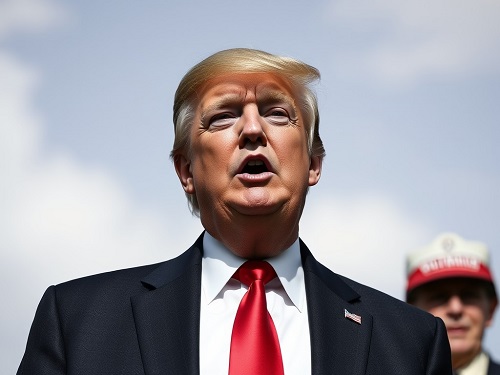
On Tuesday, December 17, 2024, Newsweek reported that Judge Juan Merchan’s ruling regarding Donald Trump’s hush money case is expected to impose significant limitations on the president-elect’s actions during his upcoming term. Legal analyst Jonathan Turley commented that the judge’s decision could effectively place Trump under a “leash,” as he may face sentencing after his presidency concludes in 2029.
Merchan’s ruling, which allows Trump’s conviction on 34 felony counts of falsifying business records to stand, has sparked discussions about the implications of presidential immunity. Turley noted on social media that the judge’s refusal to dismiss the conviction leaves Trump in a state of “suspended legal animation,” meaning that while he serves as president, legal proceedings regarding his case could remain unresolved.
The Manhattan District Attorney, Alvin Bragg, has proposed various options for managing Trump’s conviction, including the possibility of placing the case in a permanent state of suspended animation. This would allow Trump’s conviction to remain intact while he is in office, effectively freezing any potential appeals or further legal actions. However, the viability of this option under New York law remains uncertain.
Turley emphasized that the ruling allows Judge Merchan to maintain control over Trump’s legal situation throughout his presidency. The prospect of Trump governing while facing the stigma of a pending conviction is seen by some Democrats as a preferable scenario, given the low likelihood of a jail sentence.
In his ruling, Merchan addressed arguments made by Trump’s legal team, which contended that the U.S. Supreme Court had granted the former president immunity for official acts performed during his presidency. Trump’s lawyers argued that prosecutors had relied on testimony from former White House communications director Hope Hicks about her conversations with Trump regarding the scandal, as well as on Trump’s social media posts. However, Merchan determined that these actions were related to personal matters rather than official presidential duties.
According to Merchan, the use of personal conduct as evidence of criminal activity poses no threat to the authority of the Executive Branch. He further clarified that the Supreme Court has explicitly stated that a president’s public statements, including those made on social media, can be considered as evidence of criminal behavior.
Merchan denied Trump’s request to overturn the jury’s conviction from May, which was based on a $130,000 payment made by Trump’s attorney, Michael Cohen, to adult film actress Stormy Daniels. This payment was intended to prevent Daniels from discussing an alleged affair with Trump during the 2016 election campaign. Trump has pleaded not guilty to the charges.
The ruling indicates that although Trump cannot be sentenced while serving as president, he may face legal consequences once he leaves office. Trump’s legal team has argued that the Supreme Court’s previous decisions regarding immunity should apply to his case, claiming that his actions fell within the scope of his presidential duties.
In response to the ruling, Trump spokesperson Steven Cheung criticized Judge Merchan, alleging bias and claiming the decision contradicts the Supreme Court’s stance on presidential immunity. Cheung asserted that the American public has re-elected Trump with a strong mandate, calling for an end to what he described as the “weaponization” of the justice system.
Conversely, Richard Painter, a former White House ethics lawyer and critic of Trump, supported Judge Merchan’s decision, stating that the case pertained to personal conduct rather than official acts. Painter suggested that the likelihood of jail time is low and that sentencing would likely be postponed while Trump serves his term.
Looking ahead, CNN’s Kara Scannell noted that the next significant development in the case will revolve around whether Trump can face sentencing in 2029. As Trump’s legal team prepares to appeal the ruling, the implications of presidential immunity and the potential for future legal challenges remain at the forefront of discussions surrounding this high-profile case.
Source: Newsweek


